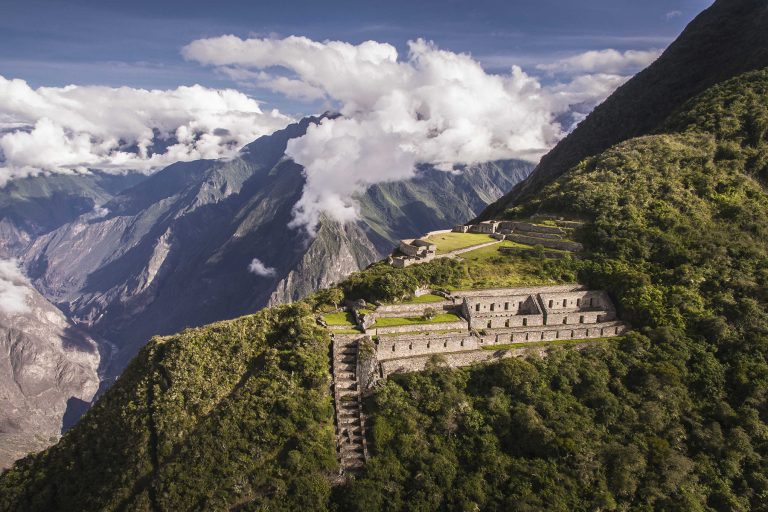
The Choquequirao Trek is widely recognized by mountain guides as the most physically challenging standard trekking route in the Cusco region. While high-altitude circuits like Ausangate (reaching over 5,000 meters) challenge hikers through thin air and freezing cold, Choquequirao tests stamina through brutal verticality, steep switchbacks, and intense canyon heat.
The Double Canyon Challenge: Why Choquequirao is So Demanding
Most Andean treks climb gradually along river valleys up to a high pass before descending. Choquequirao forces the reverse: you begin high at the Capuliyoc ridge (2,900m), drop 1,500 vertical meters into the throat of the Apurímac Canyon, and then climb 1,400 vertical meters up to Marampata on the other side. On your return hike, you must repeat the exact same 1,400-meter descent and 1,000-meter climb back up to Capuliyoc.
Metric
Choquequirao Trek 4D
Classic Inca Trail 4D
Salkantay Trek 5D
Total Vertical Gain/Loss
Over 5,800 m total movement
Approx. 3,200 m total movement
Approx. 3,800 m total movement
Maximum Altitude
3,050 m (10,006 ft)
4,215 m (Dead Woman’s Pass)
4,630 m (Salkantay Pass)
Primary Physical Strain
Knee impact, quad fatigue & heat
Inca stone stairs & pass altitude
High pass altitude & distance
Difficulty Rating
Level 4.5 / 5 (Strenuous)
Level 3 / 5 (Moderate)
Level 3.5 / 5 (Moderate-Challenging)
Medical Perspective: Because Choquequirao stays below 3,100 meters, Acute Mountain Sickness (AMS) is far less common here than on Ausangate or Salkantay. However, dehydration and heat exhaustion are genuine hazards on the exposed canyon walls, where radiant rock temperatures often exceed 30°C (86°F).
Essential Physical Preparation Guidelines
Eccentric Quad Training: Focus your gym routine on step-downs, Bulgarian split squats, and weighted lunges. Eccentric quadriceps contractions control your descent down 1,500 vertical meters of loose dirt.
Trekking Poles are Mandatory: Quality telescoping poles with carbide tips absorb up to 25% of the compressive load on your knees during the downhill legs.
Early Trail Departures: Hiking between 5:30 AM and 9:30 AM allows you to complete the bulk of the canyon climb in mountain shade before the midday sun radiates off the canyon walls.
Official Mountain Expedition
Ready to Conquer the Apurímac Canyon & Choquequirao?
Trek 4 days into the last Inca citadel with licensed mountain guides, pack mules, 4-season camps, and certified WAFA wilderness first responders.