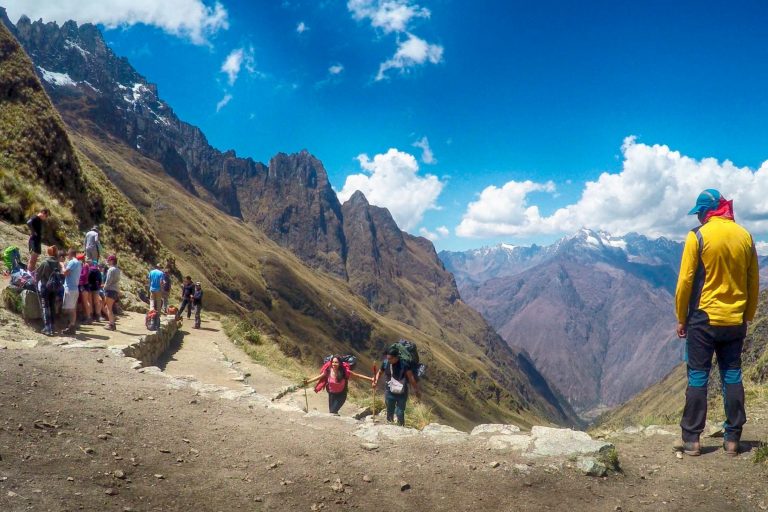
Many travelers assume Machu Picchu is the only significant archaeological site in the sanctuary. In reality, the Classic Inca Trail 4 Days is an open-air archaeological corridor preserving fortified citadels, astronomical observatories, and terraced agricultural stations built high along the mountain crests. Ancient complexes such as Patallacta, Runkurakay, Sayacmarca, Phuyupatamarca, and Wiñay Wayna are accessible exclusively on foot along this stone trail, turning the hike into a world-class archaeological journey.
📌 Archaeological Sites Along the Inca Trail
- Patallacta (2,750 m / 9,022 ft): Extensive agricultural settlement with terraced sectors overlooking the Cusichaca River on Day 1.
- Runkurakay (3,760 m / 12,335 ft): Semi-circular military watchtower and messenger post perched below the second pass on Day 3.
- Sayacmarca (3,620 m / 11,876 ft): Fortified mountain citadel perched on a steep granite ridge with stone ritual aqueducts.
- Phuyupatamarca (3,680 m / 12,073 ft): “The Town in the Clouds,” renowned for its six ceremonial granite baths fed by natural springs.
- Wiñay Wayna (2,650 m / 8,694 ft): The most elaborate architectural ruin on the trail, featuring cascading agricultural terraces.
Sayacmarca and Phuyupatamarca: Military and Hydraulic Engineering
Day 3 reveals the height of Inca masonry and civil engineering. After crossing the second mountain pass at 3,950 m (12,959 ft), the stone pathway leads to Sayacmarca (“Inaccessible Town”), a cliffside fortress entered exclusively by a narrow stone staircase carved along a vertical precipice. Its residential quarters and stone aqueducts demonstrate sophisticated strategic defense guarding the imperial trail.
Continuing along stone-paved highways and through prehistoric tunnels carved directly through living rock, you arrive at Phuyupatamarca. Perched on a high ridge overlooking the Urubamba canyon at 3,680 m (12,073 ft), this complex features six stepped ceremonial water fountains interconnected by underground channels that continue to function with hydraulic precision more than five centuries after construction.

Wiñay Wayna: The Sacred Gateway to Machu Picchu
Descending into the dense cloud forest at 2,650 m (8,694 ft), you encounter the stunning citadel of Wiñay Wayna (“Forever Young” in Quechua). Built against a steep mountain slope dropping toward the river, it holds over forty curved agricultural terraces shaped to the mountain contour, a ceremonial sector with ten ritual baths, and residential quarters for the Inca priestly elite.
Camping nearby allows our groups to explore Wiñay Wayna unhurriedly in late afternoon, when golden light warms the granite masonry and cloud-forest silence settles over the site, providing a quiet preview before the final walk to the Sun Gate the next morning.
Chronology of Archaeological Ruins on the Trail
| Inca Monument | Historical Function & Key Feature |
|---|---|
| Patallacta (Day 1) | Agricultural and administrative center supplying imperial travel retinues. |
| Runkurakay (Day 3) | Semi-circular military outpost and messenger rest stop (tambo). |
| Sayacmarca (Day 3) | Cliffside defensive stronghold with stone aqueducts carved into solid rock. |
| Phuyupatamarca (Day 3) | Astronomical observatory and six ritual stone baths with valley views. |
| Intipunku (Day 4) | Sun Gate • Ceremonial portal providing the first view of Machu Picchu. |
The Importance of Certified Guides with Archaeological Training
Walking through these ancient complexes without historical context reduces the experience to looking at bare stone walls. Our university-graduated guides explain the cosmological alignment of solstice windows, the mechanics of sub-surface drainage channels, and the social organization required to construct stone settlements along sheer mountain precipices.
Just a short distance from Wiñay Wayna lies Intipata (2,840 m / 9,317 ft), a massive series of agricultural terraces following the curve of the mountain. This site served as an agronomic laboratory to acclimatize subtropical crops before sending them to the Inca nobility at Machu Picchu, showcasing stone irrigation canals that still direct spring water smoothly today.
The masonry throughout these ruins features proven seismic-resistant engineering: walls canted slightly inward, symmetrical trapezoidal doorways and windows, and granite blocks fitted with fine joint tolerances without mortar. Seeing these structures withstand Andean earthquakes for over five hundred years shows the skill of a civilization that built with deep understanding of their mountain environment.