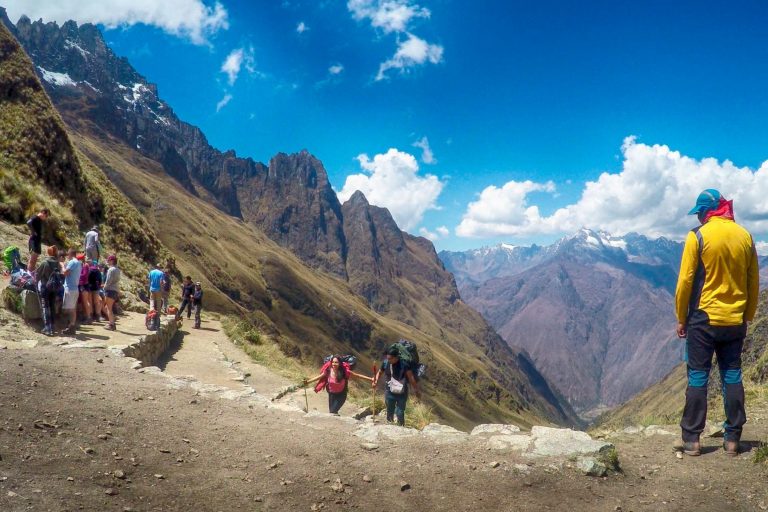
Technical Rating: The Classic Inca Trail ranks firmly at a Level 4 out of 5 (Challenging). While technical rock-climbing skills and ropes are not required, the genuine challenge stems from sustained cardiovascular exertion at high altitude, steep ascents across thousands of irregular stone steps, and crossing the demanding pass of Dead Woman’s Pass (Warmiwañusqa) at 4,215 m (13,828 ft). Operated directly by Inka Jungle Tour under official MINCETUR license in Cusco, our groups hike with medical oxygen cylinders, WAFA wilderness first-aid certified guides, and porter support carrying all heavy gear.
Many travelers underestimate the Inca Trail, assuming it resembles a standard countryside nature hike. The operational reality is different. You do not struggle primarily against mileage (43 km / 26.7 miles over four days is modest); you struggle against verticality, uneven stone surfaces, and reduced oxygen saturation at over 4,000 meters. Understanding the technical specifications beforehand transforms anxiety into disciplined preparation.
🧮 Technical Analysis of Physical Demands
- Key Trail Metrics:
- Difficulty Rating: 4 / 5 (Challenging – Not suited for completely sedentary lifestyles)
- Total Distance: 43 km (26.7 miles)
- Highest Elevation: 4,215 m (13,828 ft) at Warmiwañusqa Pass
- Terrain: 80% ancient irregular stone steps, high stone risers, packed dirt
- Daily Hiking Duration: 6 to 8 hours per day on average
- Emergency Oxygen: YES (Mandatory medical cylinder carried by staff)
- Ideal Season: April to October (Dry trails, solid stone grip)
The “Leg-Breaker” Factor: The real challenge is the stairs. Unlike modern trails engineered with gradual switchbacks, Inca engineers constructed pathways directly uphill and down. Steps range from shallow 10 cm risers to steep 40 cm stone blocks, forcing your quadriceps, hamstrings, and calves to constantly adapt.
🕒 The Day-by-Day Difficulty Curve
Physical effort on the Inca Trail is not uniform. Managing your energy across the four days is critical to prevent premature exhaustion.
Day 1: The Gentle Introduction (Moderate)
Rolling terrain along the Vilcanota River. Mostly gentle uphill grades (“Andean flat”). Do not rush here; use this stage to dial in your breathing rhythm, hydrate, and break in your trail routine.
Day 2: The Vertical Crucible (Demanding / Strenuous)
The defining day. You climb 1,200 vertical meters over 4 to 5 hours to reach Dead Woman’s Pass (4,215 m). The air is cold and thin. The key is steady rhythm: one breath, one step. The subsequent descent into Pacaymayo requires careful foot placement on steep stone stairs.
Day 3: The Technical Endurance Challenge (Challenging)
While less intense in pure elevation than Day 2, this is the longest day in distance (16 km). You surmount a second pass at Runkurakay (3,950 m) and face the sustained descent known as the “Gringo Killer”—hundreds of downward stone stairs toward Wiñay Wayna.
Day 4: The Triumphant Final Stretch (Easy / Moderate)
Pure exhilaration. The walk to the Sun Gate (Inti Punku) takes about two hours along relatively flat cliffside trails, punctuated by a short 50-step vertical scramble before revealing Machu Picchu.
Porter Support Guarantee:
You do not carry a heavy expedition pack. On our Classic Inca Trail, licensed porters transport all camping gear, food supplies, and up to 5 kg of your personal duffel bag. You hike with only a lightweight daypack holding water, windbreaker, and camera.
🧑🚶️ Who Can Hike the Inca Trail? (Honest Reality Check)
You do not need to be an ultra-marathoner. We routinely guide active travelers in their 60s and adventurous teenagers. The decisive factor is mental perseverance and base cardiovascular stamina. If you can walk for five consecutive hours in hilly terrain and have no serious joint or cardiac conditions, you are equipped to complete the trek.
✅ You will succeed if: You maintain a positive attitude toward backcountry discomfort, complete 2 months of basic stair-climbing conditioning, and value cultural history over resort luxury.
❌ Reconsider if: You have acute knee injuries (meniscus/ligaments), severe respiratory conditions, or cannot tolerate backcountry tent camping.

🧠 How to Reduce Trail Difficulty: Comfort Engineering
While trail difficulty is physical, unnecessary suffering is optional. Smart preparation reduces trail fatigue by up to 40%:
- Trekking Poles with Rubber Tips: Essential for absorbing impact on steep downhill stairs and transferring 25% of load off your knee joints.
- Broken-in Hiking Boots: Never wear brand-new footwear. Break your boots in thoroughly on multi-hour training walks weeks before arrival.
- Proper Acclimatization: Spend a minimum of 48 hours in Cusco (3,400 m) or the Sacred Valley (2,870 m) before your trek starts.
📅 Conquer the Trail with Professional Logistics
The Inca Trail is a demanding journey, but that physical commitment is precisely what makes stepping through the Sun Gate so profoundly satisfying. Review our packing list guide and let our field team manage the heavy lifting while you focus on the trail.
📅 Check live availability and book your Classic Inca Trail expedition today.
Ready to conquer the pass? View departures and permit dates for the Classic Inca Trail 4 Days.