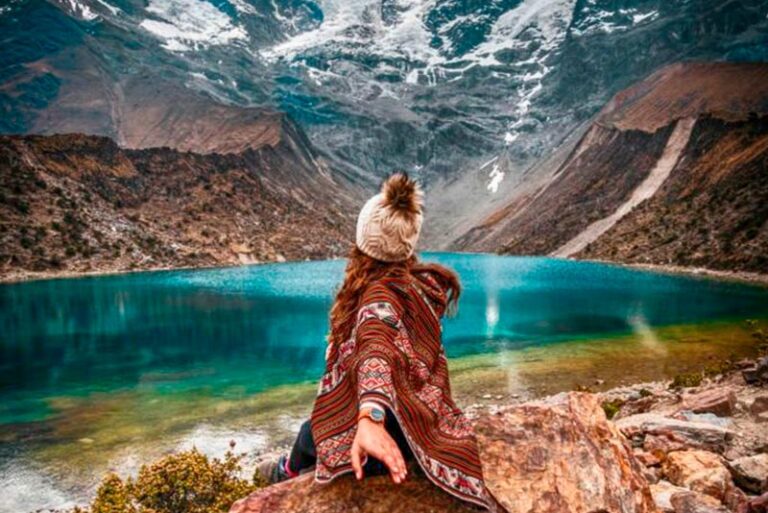
📌 Mountain Psychology: Conquering Day 2 on Salkantay
- Physical Challenge: Ascending 730 vertical meters from Soraypampa (3,900 m) to the Salkantay Pass at 4,630 m (15,190 ft).
- The 7 Snakes Switchbacks: Relentless 45-degree rocky switchbacks demanding rhythmic breathing and short, deliberate steps.
- Mental Strategy: Break the climb into 15-minute segments; avoid looking up at the ridge and synchronize pole strikes with inhalations.
- Emergency Horse Escort: An emergency saddle horse shadows the group up the pass in case of severe exhaustion or altitude fatigue.
- The Descent into Warmth: A 13 km descent dropping 1,730 vertical meters into the cloud forest at Chaullay (2,900 m / 9,514 ft).
Day 2 of the Salkantay Trek is the crucible of the expedition. Leaving Soraypampa camp at 5:30 AM in sub-zero frost, your breath forms white clouds as you gaze up at the glaciated face of Apu Salkantay (6,271 m / 20,574 ft). Reaching the high pass at 4,630 m (15,190 ft) is less a test of muscular power than a battle of mental discipline, pacing, and focused breathing.
Ascent Psychology: Managing the Urge to Give Up
Above 4,200 meters, atmospheric pressure falls to approximately 60% of sea-level value. Your pulse accelerates, legs feel heavy, and an inner voice often suggests turning back. Experienced mountain guides understand this psychological friction well: it is a normal neurochemical response to hypoxia.
The antidote is pacing. Stop looking up at the high ridge—it creates visual despair because distances in thin alpine air appear deceptive. Focus exclusively on the two meters of trail directly ahead. Step in rhythm with your breathing: one inhalation per step on steep sections, matching your trekking pole strikes like a steady metronome.

The 7 Snakes (Siete Culebrillas) and Trekking Pole Technique
The crux of the climb is known as the “Siete Culebrillas” (The Seven Snakes)—a sequence of steep, rocky switchbacks where gradient tightens to nearly 40 degrees. Here, proper trekking pole technique is essential: plant both poles slightly ahead, push through your triceps to unweight your quadriceps, and keep your center of gravity balanced over your midfoot.
Keep pauses short. Stopping for longer than 60 seconds allows the freezing cordilleran wind to cool your sweaty base layer, making your muscles stiff and triggering shivers. Take five deep diaphragmatic breaths through your nose, take a sip of electrolyte water, and resume a deliberate climbing pace.
Day 2 Stage and Elevation Matrix
| Trail Segment | Distance, Elevation & Operational Profile |
|---|---|
| Soraypampa to Salkantaypampa | 3 km • Gentle climb from 3,900 m to 4,100 m • Warming up in morning frost. |
| Soyrococha to Salkantay Pass | 4 km • Steep switchbacks reaching 4,630 m (15,190 ft) • Maximum effort. |
| Salkantay Pass to Wayracmachay | 6 km • Rocky moraine descent to 3,912 m • Hot lunch station. |
| Wayracmachay to Chaullay Camp | 7 km • Descending into warm high jungle (2,900 m / 9,514 ft) • Rapid oxygen relief. |
The Summit Reward and the Apacheta Stone Ceremony
Topping out at the Salkantay Pass at 4,630 m (15,190 ft) delivers an unforgettable rush of emotion. Standing between the hanging blue seracs of Salkantay to the right and the jagged granite spires of Humantay to the left, the sense of accomplishment is profound.
Our guides lead travelers in the ancient Quechua ceremony of the Apacheta: placing a small stone upon the summit cairn as a respectful offering to the Apus (sacred mountain protectors), accompanied by three coca leaves (k’intu) held between the fingers. It connects your physical effort with centuries of Andean mountain tradition.
Descent Safety and Dropping into the Subtropical Valley
Once past the pass, the challenge shifts from cardiovascular strain to knee control. You descend 13 kilometers over rocky scree and riverbanks down to Chaullay at 2,900 m (9,514 ft). Use your trekking poles to cushion every downward step, keeping knees soft and flexed.
As you drop below 3,500 meters, the transformation is astonishing: thin glacial air transforms into sweet, warm, oxygen-packed cloud-forest breeze. Flowers appear, streams rush past green slopes, and by the time you reach Chaullay camp for a hot dinner, your lungs feel completely restored.