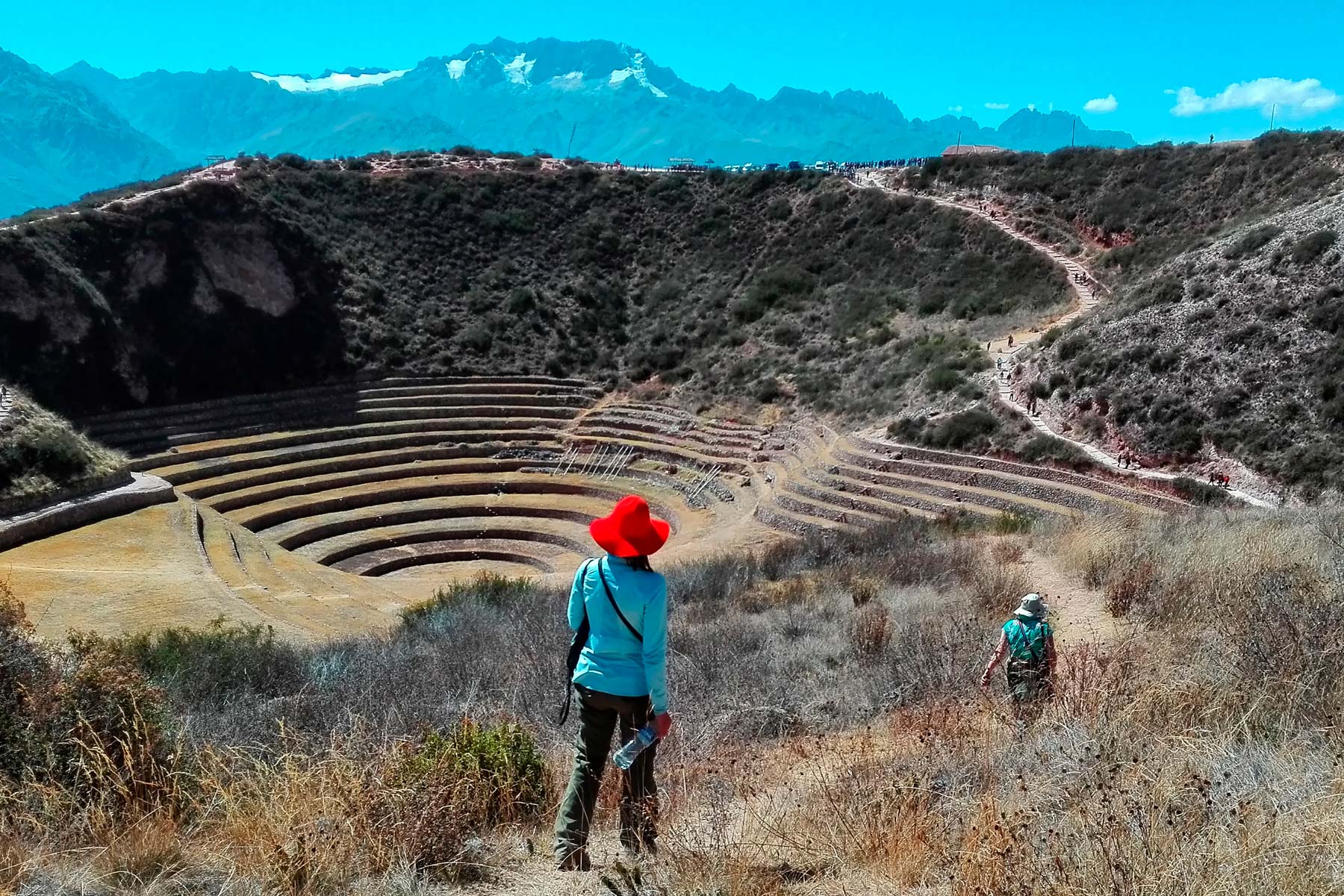
Just 50 kilometers northwest of Cusco lie the mysterious Moray circles, an impressive structure that has become an essential destination for travelers exploring the region. While often attributed to the Incas, some theories suggest that their origins could date back to pre-Inca cultures that already took advantage of the site’s unique features.
📌 Scientific Brief: Moray Archaeological Terraces
- Location & Elevation: Maras District, Sacred Valley, at 3,500 m (11,482 ft) above sea level.
- Core Structures: 4 natural geological depressions (sinkholes) transformed into terraces: Q’echuyoq (the largest), Simamuyoq, Ñustap’ajsanan, and Intiwatana.
- Proven Microclimate Gradient: Temperature difference of up to 15°C (27°F) between the lower floor and upper rim.
- Admission Ticket: Cusco Tourist Ticket (BTC General Ticket or Partial Circuit III).
- Best Visiting Hours: Early morning (08:30 – 10:30 AM) or mid-afternoon (02:30 – 04:30 PM) for optimal lighting.
Moray, with its amphitheater-like design of circular terraces, is much more than a simple archaeological curiosity; it is a clear reflection of engineering and adaptability. Located over 3,500 meters above sea level in the Sacred Valley, this complex reveals a profound knowledge of climatic and agricultural conditions.
The Agricultural Laboratory of the Andes
The Moray circles are recognized primarily as a sophisticated experimental agricultural laboratory. The key to their functionality lies in the notable temperature variation between the top and bottom of the terraces, which can reach up to 15°C (59°F).
This system allowed the builders to create distinct microclimates at each level. The terraces feature a complex irrigation system and are filled with fertile soil. It is presumed that, by replicating the conditions of various altitudinal levels, the Incas were able to study how regional changes affected the growth of essential crops such as quinoa, kiwicha, squash, pumpkin, corn, and various varieties of potatoes.
Corn, in particular, was fundamental to the Inca Empire. It was cultivated in thousands of varieties, from large grains to purple types. It is believed that Moray may also have served to calculate the annual production in different parts of the Tahuantinsuyo.
An Enigma Called Moray
Despite its recognition as an agricultural center, the exact origin and etymology of the word Moray remain an enigma. Although it is related to Quechua and terms like “Aymoray” (corn harvest or the month of May) and “Moraya” (dehydrated potato), the lack of Inca written language leaves room for multiple interpretations.
In addition to its agricultural function, other theories have been proposed regarding its use, including that it may have been a ceremonial center or even a repurposed open-pit mine.
| Terrace Sector in Moray | Thermal Conditions & Experimental Crops |
|---|---|
| Terrazas Basales Profundas (Fondo) Fondo de la dolina principal Q’echuyoq |
Microclima subtropical protegido de vientos. Ensayos de maíz de grano gigante, plantas medicinales de selva y hojas de coca. |
| Terrazas Intermedias (Nivel Medio) Zona de transición térmica templada |
Ambiente templado similar a los valles interandinos (2,800 m (masl)). Cultivo de quinua real, kiwicha, tarwi y legumbres andinas. |
| Terrazas Superiores (Borde Exterior) Exposición plena a heladas y viento de puna |
Clima frío de alta montaña (3,500+ m (masl)). Ensayos de papas amargas resistentes a la helada, mashua, oca y olluco. |
Discover the Ancestral Engineering in Moray
Exploring Moray is to immerse oneself in the advanced engineering of Andean cultures. The terraces, built into natural depressions, demonstrate not only exceptional management of water and soil but also a deep respect for nature.
If you are looking for an experience that combines history, engineering, and dramatic Andean landscapes, a visit to Moray is indispensable.
The Thermal Gradient: A 15°C Microclimate Agricultural Laboratory
What sets Moray apart from any ordinary Inca agricultural site is its extraordinary thermodynamic design. Located on a high limestone plateau at 3,500 meters (11,483 feet) above sea level, the main depression (Q'echuyoq) drops nearly 150 meters (492 feet) deep. Between the uppermost rim and the lowest circular terrace, modern agronomists and meteorologists have recorded temperature differentials of up to 15°C (27°F).
The orientation of the terraces relative to the sun trajectory and prevailing valley winds, combined with the thermal mass of the dark stone retaining walls (which absorb solar radiation during the day and radiate heat overnight), created over 20 distinct microclimatic zones. This enabled Inca agricultural botanists to acclimatize wild jungle crops, maize varieties, and high-altitude tubers before cultivating them across the wider Tahuantinsuyo empire.
Subsurface Drainage & Hydraulic Engineering
Despite being a closed subterranean funnel, Moray never floods—even during the heaviest torrential downpours of the Andean rainy season (January to March). The bottom terraces rest upon a naturally porous limestone bedrock layered with graded gravel, sand, and fine topsoil brought from different ecological regions. This sophisticated natural drainage system absorbs excess runoff instantly, filtering water deep into subterranean aquifers.