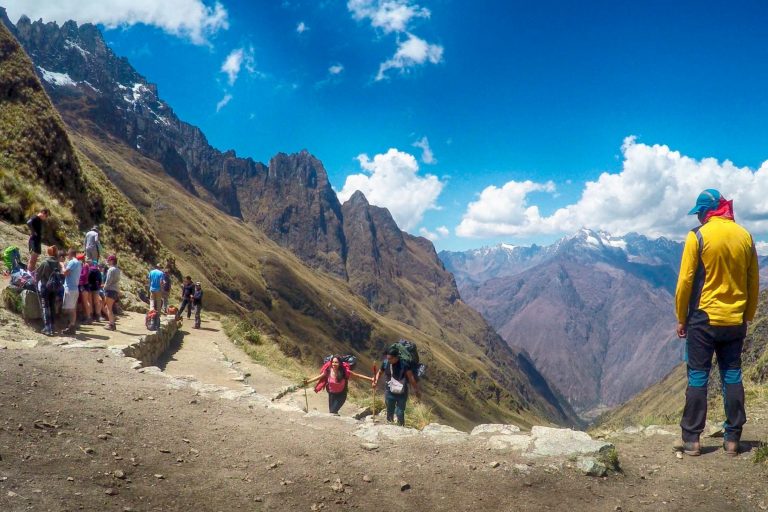
When preparing your gear for the Classic Inca Trail 4 Days, the most frequent packing confusion revolves around weight allocation: what items belong in your personal daypack during the hike, and what goes into the duffel bag transported by porters? Understanding how luggage logistics operate on the trail and respecting the strict weight limits set by Peru’s Porter Protection Law is essential for your comfort and for the safety and welfare of the Andean support team.
📌 Golden Rule: Gear Distribution on the Inca Trail
- Agency-Provided Duffel Bag: Heavy-duty canvas bag with a strict maximum limit of 6 kg (13.2 lbs) per hiker.
- Duffel Bag Contents: Sleeping bag, sleeping pad, change of evening campsite clothes, and personal toiletries.
- Personal Daypack: Ergonomic 20-to-30-liter backpack carried by you, weighing between 4 and 5 kg (8.8 to 11 lbs).
- Daypack Contents: Hydration water, daytime trail snacks, basic blister kit, waterproof jacket, camera, and original passport.
- Duffel Bag Access: Only accessible upon reaching evening camps; porters hike ahead, so duffels are unavailable during daytime walking hours.
What to Keep in Your Daytime Trail Daypack
During the 6 to 8 hours of daily hiking, porters move at a brisk pace ahead of the group to set up camp and cook meals. Your duffel bag is packed into waterproof porter bundles early in the morning and will not be accessible until you arrive at the lunch stop or evening campsite. That means your personal daypack must hold everything required to manage weather changes, dehydration, and energy drops independently.
Keep at least 1.5 to 2 liters of water in a hydration bladder (Camelbak style) or reusable bottles, SPF 50+ sunscreen, UV400 sunglasses, insect repellent for lower subtropical sections, a warm fleece layer, a sturdy waterproof rain jacket or poncho, and your original physical passport for park ranger checkpoints. Keep extraneous items out of your daypack: climbing thousands of steep stone steps above 3,500 m (11,482 ft) with an 8-kilo pack exhausts your leg muscles quickly.
For cameras and smartphones, remember that sub-freezing night temperatures at high camps like Pacaymayo (0°C / 32°F) cause lithium-ion batteries to lose charge rapidly. Keep electronic gear and backup power banks tucked inside your sleeping bag overnight to keep them warm and fully operational for sunrise photos at the Sun Gate.

The 6-Kilo Duffel Limit and Packing Efficiency
Peru’s Porter Protection Law enforces strict checkpoint weighing at Piscacucho and Wayllabamba. Porters are legally capped at carrying no more than 20 kg (44 lbs) total, which includes their own sleeping gear and food rations. To respect this limit, our agency assigns a maximum of 6 kg (13.2 lbs) per traveler in the provided duffel bag. Approximately 2 kg of that allowance is taken up by your four-season sleeping bag and inflatable sleeping pad.
That leaves roughly 4 kg (8.8 lbs) for clothing: three pairs of merino wool or synthetic trekking socks, thermal underwear for sub-freezing camp nights, lightweight camp sandals to take pressure off your feet, biodegradable toiletries, and a small microfiber towel. Seal clothing inside separate zip-top dry bags to protect against unexpected cloud-forest rain.
Daypack vs Duffel Bag Gear Breakdown
| Gear Item | Location & Operational Reason |
|---|---|
| Original Passport & Cash Soles | Personal Daypack • Required at SERNANP trail entry checkpoints. |
| Hydration & Energy Snacks | Personal Daypack • Continuous hydration and calorie intake during hikes. |
| Waterproof Gore-Tex Shell | Personal Daypack • Sudden weather and rain changes at high mountain passes. |
| Four-Season Sleeping Bag | Duffel Bag (Porter) • Used exclusively inside your tent at night. |
| Dry Evening Camp Clothing | Duffel Bag (Porter) • Clean thermal layers for resting after daily hikes. |
What to Store Safely at Your Cusco Hotel
Your heavy hard-shell rolling suitcases, dress clothing, formal footwear, laptops, and souvenir shopping should stay behind in secure storage at your hotel in Cusco. Every reputable hotel in the historic center provides this luggage storage service free of charge. During our pre-trek evening briefing, our lead guide uses a handheld digital luggage scale to weigh your packed duffel bag, ensuring your kit complies with official regulations before you head to the trailhead.